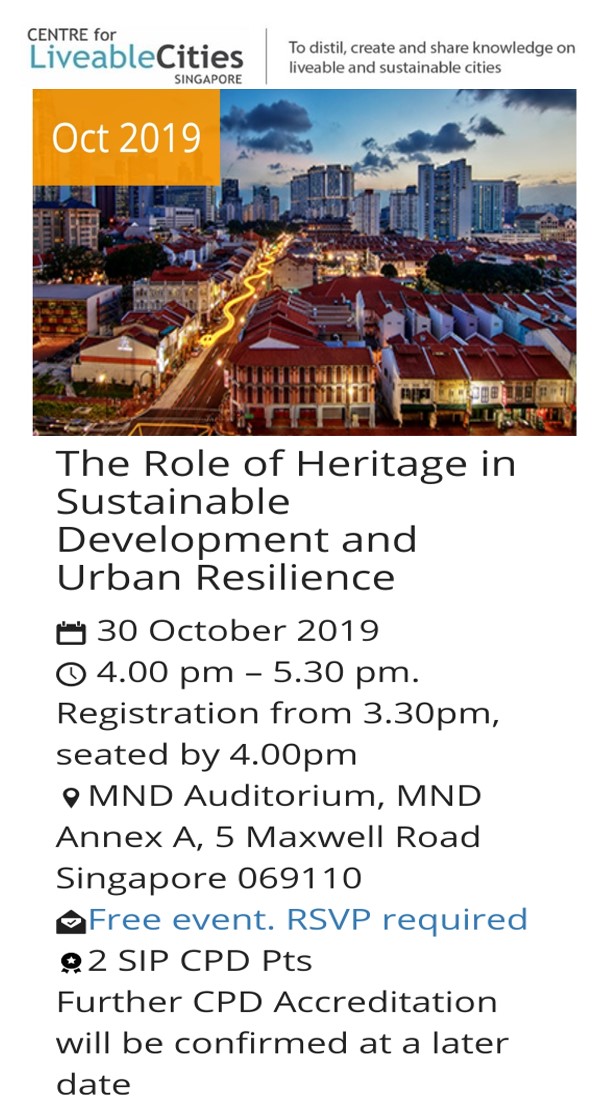
The Role of Heritage in Sustainable Development and Urban Resilience


Event Synopsis
|
When the concept of Sustainable Development first entered the international vocabulary, the focus was almost exclusively on the environment. As the understanding of the complexity of sustainable development grew, however, it was recognized that economic and social responsibility were equal pillars to environmental responsibility. More recently, the contributions of heritage to all three of the components began to be acknowledged, culminating in the formal inclusion of heritage as part of the UN Sustainable Development Goals in 2015 and in UN Habitat’s New Urban Agenda in 2016.
In the last decade cities around the world have begun to realize that “sustainability” is not achievable without a corresponding strategy of “resilience”. As strategies began to be formulated, many cities have recognized that heritage is a key component of a comprehensive program of resiliency as well. This presentation will look at the ways that heritage contributes to both sustainable development and resiliency, identify how heritage is being incorporated into international frameworks, and describe current efforts to broaden the understanding of the sustainability/heritage/resiliency links.
About the Speakers SPEAKER Donovan Rypkema is president of Heritage Strategies International. HSI was established in 2004 as a companion firm to Place Economics, a consulting firm of which Rypkema is the principal. The activities of HSI focus on the intersection between the built heritage and economic development. He has undertaken assignments in 9 Canadian provinces and nearly 50 countries in North and South America, Europe, East Asia, the Middle East, Africa, and Australia and the Pacific. He teaches a graduate course in heritage economics at the University of Pennsylvania where he received the 2008 G. Holmes Perkins Award for Distinguished Teaching. In recent years he has also taught an intensive planning praxis course taking Penn students to Shanghai, Belgrade, and Yangon.
MODERATOR HO Weng Hin graduated from NUS Department of Architecture, and obtained his postgraduate degree in conservation from the University of Genoa, Italy with top honours. He is a partner of Studio Lapis, an architectural conservation consultancy involved in major local and regional projects such as the Capitol and South Beach developments, and The Peninsula Yangon. Its work has garnered accolades such as the the URA Architectural Heritage Awards, and the UNESCO Asia Pacific Heritage Awards for the restoration of the Cathedral of the Good Shepherd. |
Galleries