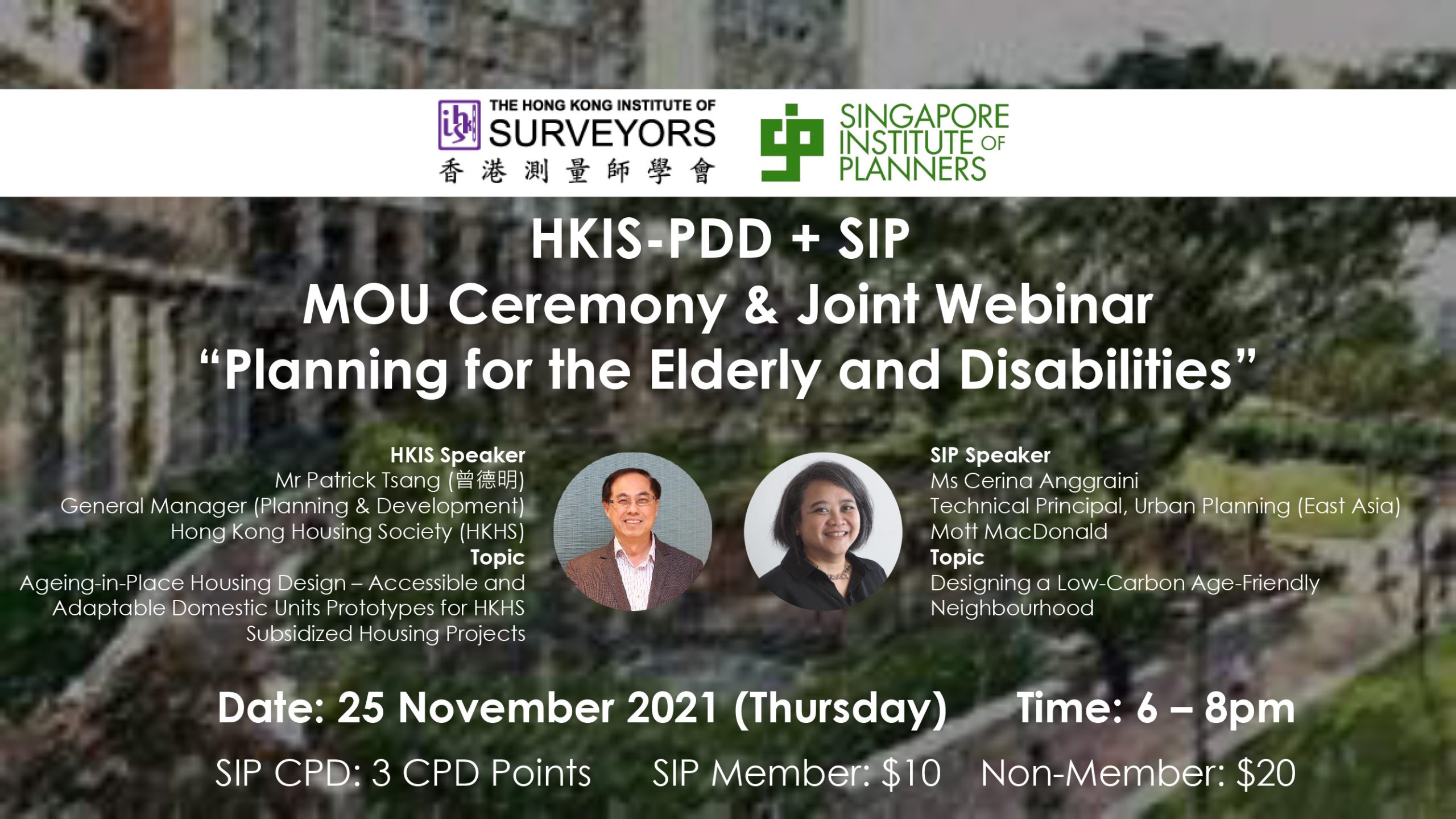
HKIS-PDD + SIP MOU Ceremony & Joint Webinar


Event Synopsis
|
HKIS Speaker Mr Patrick Tsang General Manager (Planning & Development) Hong Kong Housing Society (HKHS) Topic Ageing Place Housing Design – Accessible and Adaptable Domestic Units Prototypes HKHS Subsidized Housing Projects The architectural design of most existing public and private housings in Hong Kong is intended for residents who are independently mobile and physically fit. However if the residents have poor physical health and mobility issues, an age-friendly housing environment would allow them to age in place, thus delaying their need to move into the Residential Care Homes for the Elderly until they are unable to take care of themselves and rely entirely on others. For example, an accessible domestic unit allows people in need of mobility aid to access essential areas within the flat;or a well-designed adaptable domestic unit allows flexible conversions to incorporate accessible designs according to the degree of mobility when the residents get older. In response to the ageing population, Hong Kong Housing Society (HKHS) has assumed the role of a “housing laboratory” to provide accessible and adaptable domestic units to meet the changing community needs, and is taking a leading role in exploring housing model embracing “ageing in place” and “intergenerational living”. The presentation will share with the participants the main objectives and principles of designing accessible and adaptable units for people of all ages, inclusive design for people of all abilities, as well as enhancement on the interior design in terms of sustainability, liveability, manoeuvrability and space planning with the application of age-friendly equipment such as height adjustable wash basin,sliding door, folding door and window operators. SIP Speaker Ms Cerina Anggraini Technical Principal, Urban Planning (East Asia) Mott MacDonald Topic Designing Low-Carbon Age Friendly Neighbourhood Singapore has begun to recognize that its population is ageing rapidly since 1980s. The government has since put in place changes in policies of healthcare, social security, and housing to suit the ageing population, as well as upgrading the physical infrastructure to cater for an older population. In 2018 a research project to look into creating age-friendly neighbourhood and developing a pilot project to test the ideas was conducted, under L2NIC (LandLiveability National Innovation Challenge) initiative – a multi-agency effort led by the Ministry of National Development (MND) and the National Research Foundation under Prime Minister’s Office. The neighbourhood of Hong Kah North was one of the identified pilot projects where the proposed ideas were implemented. On another note, Singapore has set a 2030 and 2050 target to peak carbon emission and net zero target, but yet to specify a net zero target year. National transformation strategies have been identified for all sectors to act on, including to built environment at neighbourhood/precinct level. Given the high-density urban development of Singapore, precinct-scale built environment infrastructureis one of the key contributors to its carbon emissions. As a cluster of urban blocks,a precinct comprises both buildings and precinct level infrastructure, a form of urban development that is critical to address in the pursuit of integrated low or zero carbon emission solutions. |
Galleries