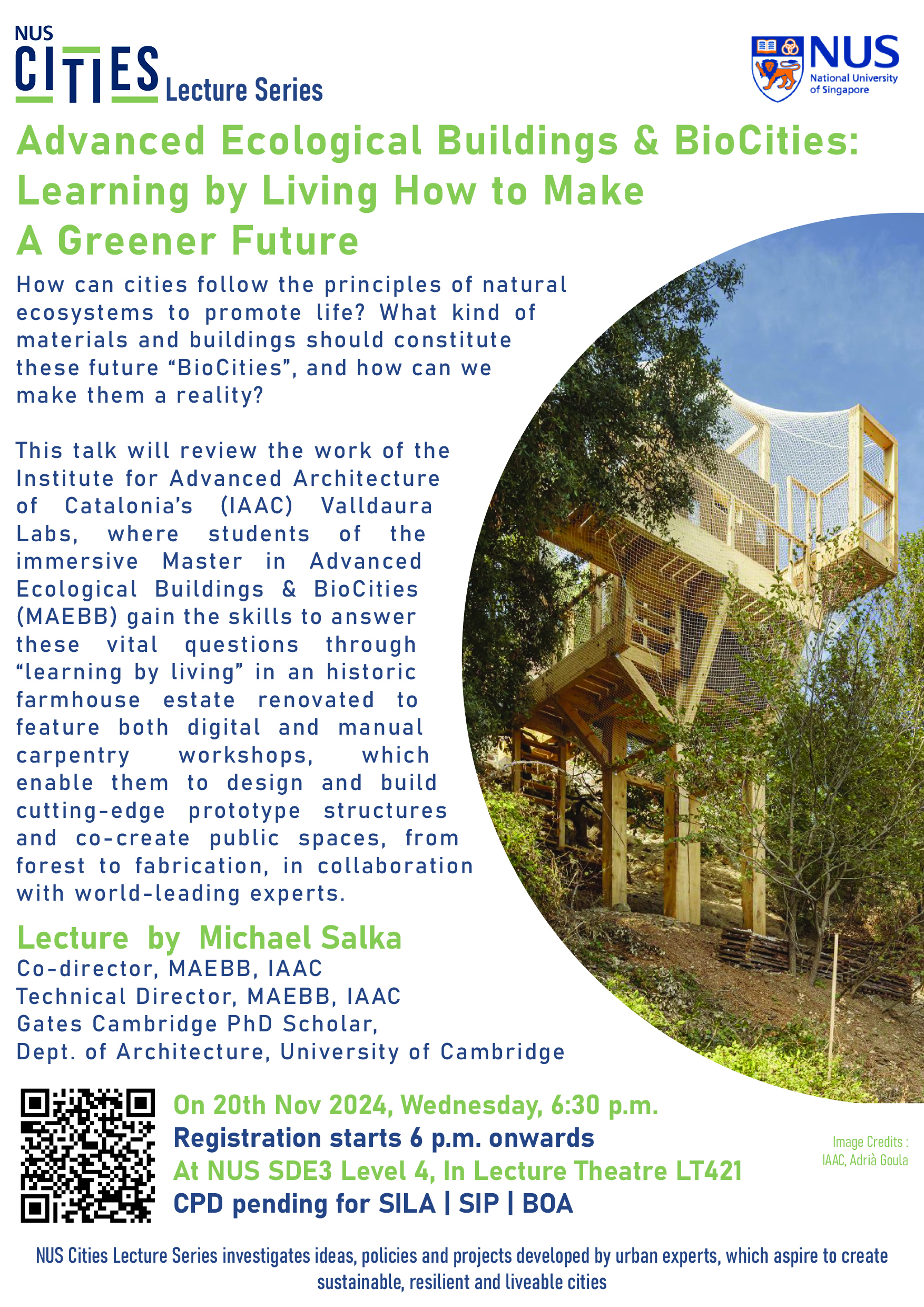
Advanced Ecological Architectures & BioCities: Learning by Living how to Build a Greener Future


Event Synopsis
|
The built environment is currently responsible for 40% of greenhouse gas emissions, 40% of material use, 30% of energy consumption, and 20% of solid waste generation worldwide. There is an urgent need to rethink building life and material cycles and how we should be building towards a sustainable built urban fabric for the future. Planners will get to hear current experiments and research on a forest to fabrication approach, through live case studies of different scales and programmes.
Speaker Michael Salka is a practising architect, educator, and researcher. He serves as Co-director of the Master in Advanced Ecological Buildings & Biocities (MAEBB) and Technical Director of Valldaura Labs at the Institute for Advanced Architecture of Catalonia (IAAC) (2022-present), whilst pursuing a PhD in Architecture at the University of Cambridge as a Gates Scholar (2021-2025). His doctorate investigates how understanding nature-based value chains as social-ecological networks can help meet the massive demand for new and renovated buildings in light of global climate change and associated crises. This is a vital challenge, given the built environment is currently responsible for 41% of greenhouse gas emissions, 40% of material use, 30% of energy consumption, and 20% of solid waste generation worldwide. His career has harnessed environmental forces through the planning, design, and construction of water infrastructures in rural Rwanda (2012-2014); net-zero neighbourhoods and mixed-use urban infill developments in the USA (2014-2018); and prototypical engineered timber buildings, public spaces, and future ‘Biocities’ in Spain (2018-present). He has published in peer-reviewed scientific journals (2013-present) and books such as Springer Nature’s Transforming Biocities (2023) commissioned by the European Forest Institute (EFI), alongside reports on bio-based social housing for the World Bank and Inter-American Development Bank (IDB) (2023). His built works have featured in popular media outlets such as The New York Times (2021). Within the Horizon Europe framework, Michael manages IAAC’s leadership of the South Hub of the New European Bauhaus (NEB) Academy (2024-2026), presently being established as the European Commission’s flagship programme to train, upskill, and reskill the construction ecosystem towards carbon-neutrality and integration of the core principles of beauty, sustainability, and inclusiveness. The NEB Academy has the stated goal of reaching 5000 professionals by 2026, 1 million by 2028, and 5 million by 2030. Michael has gained expertise in NEB methodologies as a coordinator and partner of numerous European Institute of Innovation & Technology (EIT) initiatives (2020-2024). |
Galleries