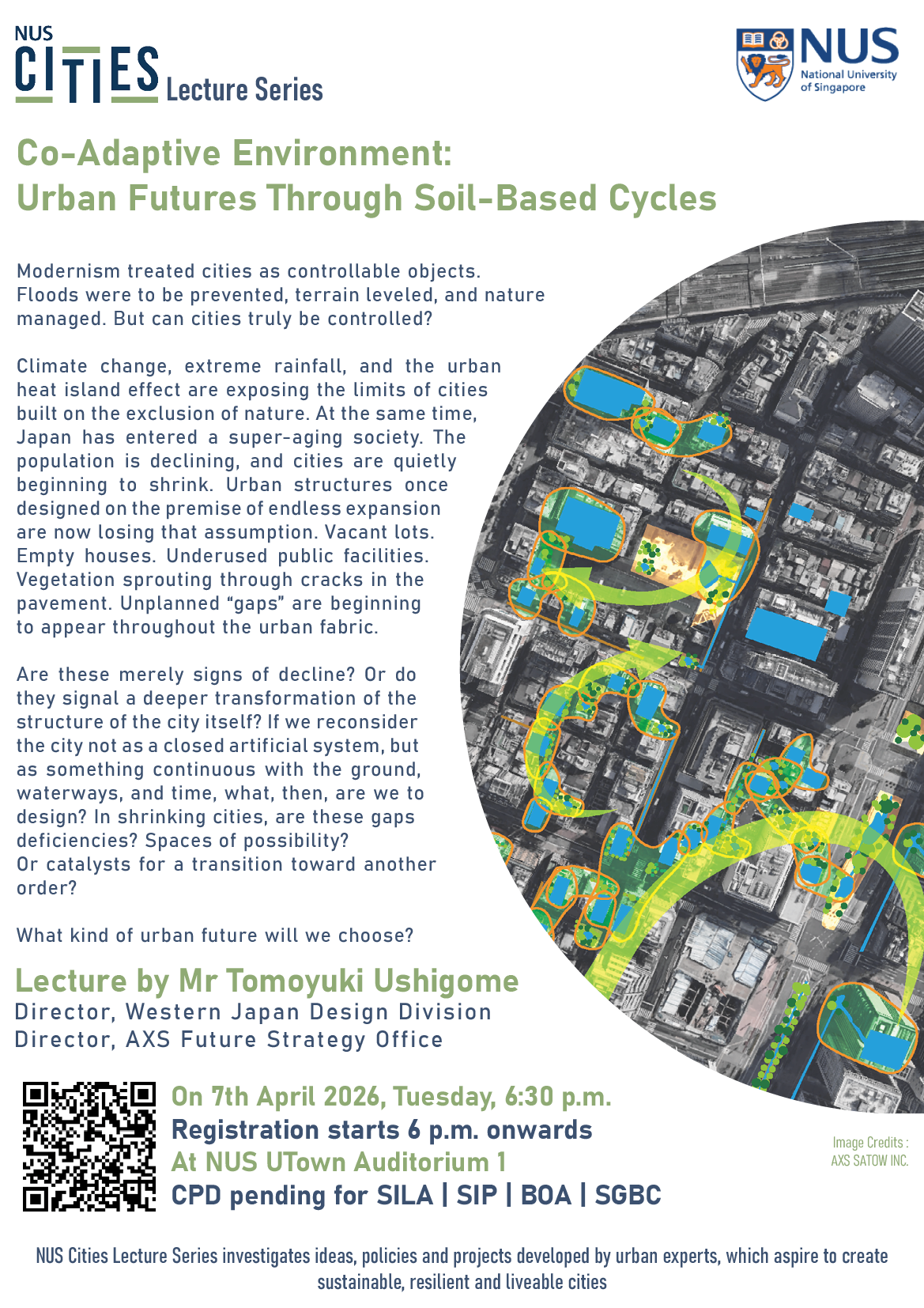
Co-Adaptive Environment: Urban Futures Through Soil-Based Cycles


Event Synopsis
|
Modernism treated cities as controllable objects. Floods were to be prevented, terrain leveled, and nature managed. But can cities truly be controlled?
Climate change, extreme rainfall, and the urban heat island effect are exposing the limits of cities built on the exclusion of nature. At the same time, Japan has entered a super-aging society. The population is declining, and cities are quietly beginning to shrink. Urban structures once designed on the premise of endless expansion are now losing that assumption. Vacant lots. Empty houses. Underused public facilities. Vegetation sprouting through cracks in the pavement. Unplanned “gaps” are beginning to appear throughout the urban fabric. Are these merely signs of decline? Or do they signal a deeper transformation of the structure of the city itself? If we reconsider the city not as a closed artificial system, but as something continuous with the ground, waterways, and time, what, then, are we to design? In shrinking cities, are these gaps deficiencies? Spaces of possibility? Or catalysts for a transition toward another order? What kind of urban future will we choose? Lecture By Mr Tomoyuki Ushigome Director of Western Japan Design Division/ Director of AXS Future Strategy Office |
Galleries