Urban Resilience in 3 Acts


Event Synopsis
|
Industry leaders will share invaluable success stories and practical implementation strategies, offering
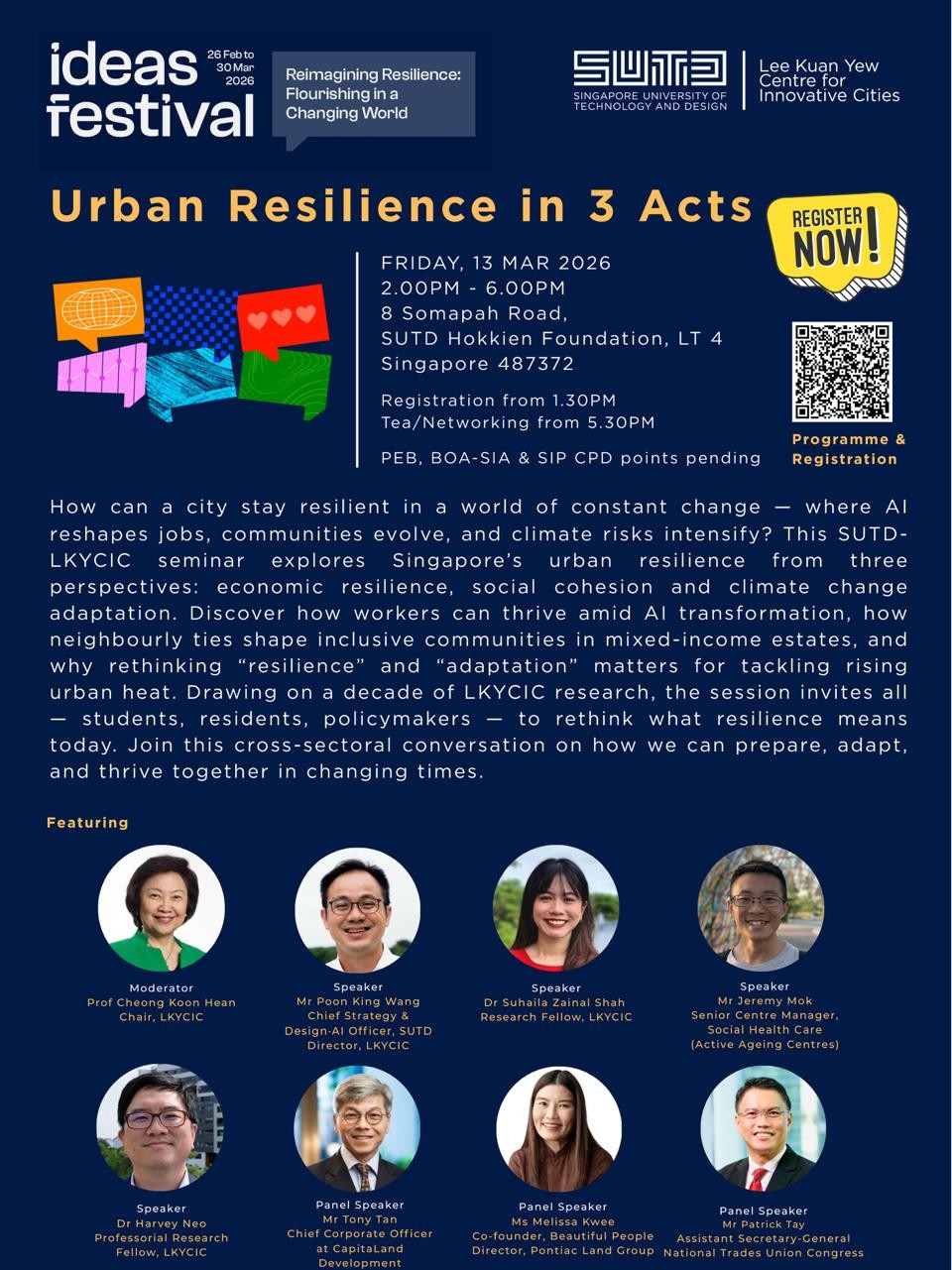
This SUTD-LKYCIC seminar explores Singapore’s urban resilience from three perspectives: economic resilience, social cohesion and climate change adaptation. In economic resilience, we share how workers can innovate and remain resilient in the age of AI, demonstrating the transformative impact of integrating the social sciences with interdisciplinary research through concrete examples from the Lee Kuan Yew Centre for Innovative Cities (LKYCIC) over the past decade of research. In social cohesion, we explore neighbourly bonds amongst residents living in mixed-income precincts in Singapore to identify factors that foster more inclusive and resilient communities. In climate change adaptation, we share how resilience and adaptation differ, why that matters, and how rethinking these concepts can improve responses to rising urban heat. A cross-sector conversation further dives into how Singapore can prepare for — and thrive amid — the challenges of a precarious time. This event is organised by SUTD as part of Social Science and Humanities Ideas Festival 2026, a collaborative showcase by social science and humanities researchers across our local universities. Programme Synopsis Economic Resilience: The Future of Innovation IS The Future of Work This presentation will explore the research insights cutting across the above, and discuss ideas on how the social sciences when paired with interdisciplinary research and practice can make an impact on people, community, economy, and society. Social Cohesion: Project BOND: Building Our Neighbourly Dynamics Singapore’s dense urban living environment and multicultural population make social cohesion/resilience particularly challenging to achieve. In Project BOND, we investigate the lived experiences and social-spatial dynamics in mixed-income HDB precincts to identify the factors that may foster stronger community ties and enhance social cohesion. The study uses a range of social sciences research methodology to obtain a deeper understanding of residents’ beliefs and actions. We will share preliminary findings on how and why residents interact differently with neighbours and conclude with possible interventions for stronger neighbourly ties. Building a Climate-Resilient Citizenry through Engaged Communities, Engaged Research, and the 3P+ Framework Although public awareness of the adverse impacts of climate change has grown, such recognition rarely translates into sustained, positive behavioural change. This disconnect reflects, on one hand, a failure to meaningfully engage citizens in climate discourse—and on the other, the persistent perception that academic research on climate issues is esoteric or detached from everyday life. Compounding this is a powerful triad of dissonance that undermines climate principles, policies, and practices: the mismatched scales, temporalities, and spatialities through which climate change is experienced and addressed. This presentation introduces a collaborative “3P+” framework that can help build a climate-resilient citizenry. We will also examine how the scalar, temporal, and spatial disconnects shape climate discourse and action. Panel Discussion The panel discussion brings together the public, private, and community sectors to explore what resilience means for a city facing intersectional challenges in the era of uncertainty. Featuring voices from a key property developer with core sustainability goals, a community activist passionate about social cohesion and a champion who safeguards workers’ future, this dialogue aims to foster discussion on how resilience can transform systems, strengthen communities, and reimagine possibilities for the future. It discusses how cross-sector partnerships and bold experimentation can help Singapore remain adaptive, inclusive, and sustainable in a rapidly changing world. Moderator |
Galleries